AP Physics 1
AP Physics 1 simulations, unit by unit
Every unit of AP Physics 1 is mechanics, and the studio has ready-made scenes for each of them: open one in the browser, press Play, and change the masses, angles and springs while it runs. Each example has a page with its formulas and the symbols defined.
Pick the unit
The eight units below follow the course; each lists the scenes that show it, with one line on what each shows.Open it in the studio
It runs in the browser, on a school laptop too: nothing to install and no account needed to try.Change a value and run it again
Students predict first, then test: a heavier mass, a steeper slope, a stiffer spring.
Unit 1
Kinematics
Position, velocity and acceleration in one and two dimensions, with constant acceleration and free fall.
- Projectile Motion: A ball launched at 40°: x at constant speed, y under g, the range against R = v₀² sin 2θ / g. Open in the studio →
- The Monkey and the Hunter: Aim straight at a falling target: both fall ½gt², so the dart hits at any launch speed. Open in the studio →
- The Chase: Car and Truck: A car starting from rest catches a truck: when they meet, and when the gap is widest. Open in the studio →
- Sliding to a Stop: Constant deceleration μg: the speed falls linearly and the block stops after v²/(2μg). Open in the studio →
Unit 2
Force and Translational Dynamics
Newton's laws, free-body diagrams, friction, springs, connected bodies, circular motion and gravitation.
- Inclined Plane: A block on a 28° ramp: it slides because the friction coefficient is below tan θ. Open in the studio →
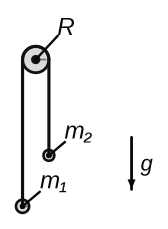
- Atwood Machine: Two masses over a pulley: the acceleration and the rope tension from Newton's second law. Open in the studio →
- Block on a Slope Tied over a Pulley: A block on a slope tied over a pulley to a hanging mass, with friction. Open in the studio →
- Crate on a Slope Held by a Rope: A crate held on a smooth slope by a rope: T = mg sin θ, with its free-body diagram. Open in the studio →
- Weight on Two Cables: A weight on two cables at different angles: both tensions from the balance of forces. Open in the studio →
- Hooke's Law: Three Masses on Springs: Three masses on identical springs: the extension is mg/k. Open in the studio →
- Apparent Weight in a Lift: A scale in a lift reads N = m(g + a): heavier speeding up, lighter slowing down. Open in the studio →
- A Block on a Board: When Does It Slip?: A block on a pulled board: static friction carries it until the pull is too large. Open in the studio →
- Tossed Hammer: Centre of Mass: A spinning hammer's centre of mass follows the parabola of a point mass. Open in the studio →
- Whirling Mass: The rod's pull on a ball moving in a circle is the centripetal force mv²/r. Open in the studio →
- Vertical Circle: Tension at the top and bottom of a vertical circle. Open in the studio →
- Banked Curve: With and Without Friction: A banked curve without friction at √(r g tan θ), and with friction between v_min and v_max. Open in the studio →
- Car over a Hump and through a Dip: Cars drive over a hump and through a dip: the road pushes m(g − v²/R) on the hump and m(g + v²/R) in the dip; above √(gR) a car takes off. Open in the studio →
- Orbits: a Planet and a Comet: A planet on a circular orbit and a comet on an ellipse under gravity. Open in the studio →
Unit 3
Work, Energy, and Power
Kinetic and potential energy, work, conservation of energy and power.
- Bouncing Ball: Energy: Potential energy becomes kinetic, v = √(2gh); each bounce keeps e² of the energy. Open in the studio →
- Mass on a Vertical Spring: Gravitational, elastic and kinetic energy trade places; the total stays constant. Open in the studio →
- Leaving the Dome: A block slides off a smooth dome and leaves it at two thirds of the height. Open in the studio →
- Winch: Work and Power: A motor lifts a load: P = Fv, and the potential energy gained is the work done. Open in the studio →
Unit 4
Linear Momentum
Momentum, impulse and collisions, elastic and inelastic.
- Elastic Collision: 1 kg at 3 m/s hits 2 kg at rest: momentum and kinetic energy are both conserved. Open in the studio →
- Perfectly Inelastic Collision: The carts stick together: momentum is conserved, a third of the kinetic energy is lost. Open in the studio →
- Impulse: Wall or Safety Net: The same change of momentum over a short and a long time: impulse J = FΔt. Open in the studio →
- Ballistic Pendulum: Momentum in the impact, then energy in the swing. Open in the studio →
- Recoil: Two Carts Pushed Apart: A spring pushes two carts apart: the total momentum stays zero. Open in the studio →
- Billiards: an Oblique Collision: An oblique collision of equal balls: they part at 90°. Open in the studio →
- Newton's Cradle: Newton's cradle: one ball in, one ball out. Open in the studio →
Unit 5
Torque and Rotational Dynamics
Torque, static equilibrium, rotational inertia and Newton's second law for rotation.
- Seesaw: Moments: Moments about the pivot balance: 4 kg at 0.75 m against 3 kg at 1.0 m. Open in the studio →
- Ladder against a Wall: A ladder against a smooth wall stands only with enough floor friction. Open in the studio →
- A Simply Supported Beam: A beam on a pin and a strut: the support reactions from moments. Open in the studio →
- Atwood, Massive Pulley: An Atwood machine whose pulley has rotational inertia: it slows the fall. Open in the studio →
- Rope Wound on a Disk: A mass on a rope wound on a disk: torque and angular acceleration. Open in the studio →
- The Yo-Yo: A yo-yo falls at ⅔ g, and the string holds a third of its weight. Open in the studio →
- Flywheel with Bearing Friction: A constant friction torque slows a flywheel linearly: ω = ω₀ − τt/I. Open in the studio →
Unit 6
Energy and Momentum of Rotating Systems
Rotational kinetic energy, rolling, angular momentum.
- Rolling Race: Slider, Discs and a Hoop: A slider, discs and a hoop race down a ramp: the shape decides, not the mass. Open in the studio →
- Disc Rolling in a V-Track: A rolling disc: the energy of its motion, of its spin and its height add to a constant. Open in the studio →
- Slipping, then Rolling: A disc and a hoop thrown without spin: friction spins them up until v = ωR. Open in the studio →
- Rod and Point Mass: the Parallel-Axis Theorem: A rod and a point mass on the same pin: I = mL²/3 changes the period. Open in the studio →
- Angular Momentum: Beads Sliding out on a Spinning Rod: Two spinning rods: on one the beads slide out, so I grows and ω falls while L = Iω stays the same; the other keeps its spin. Open in the studio →
Unit 7
Oscillations
Simple harmonic motion of springs and pendulums, its period and its energy.
- Pendulum: A simple pendulum: the period T ≈ 2π√(L/g) and its energy. Open in the studio →
- Torsional Pendulum: A torsional pendulum: T = 2π√(I/κ), whatever the starting angle. Open in the studio →
- Damped Oscillations: Under-, critically and over-damped springs side by side (beyond the course, but often asked). Open in the studio →
- Forced Oscillation near Resonance: A driven mass-spring near resonance. Open in the studio →
Unit 8
Fluids
Density, pressure and buoyancy. The studio has buoyancy only: no flow, no Bernoulli's equation.
- Archimedes: What Floats, and How Deep: Cork, pine, ice and steel in water: a floating cube sinks to d = sρ/ρ_water; steel sinks. Open in the studio →
For teachers
What is free and what is Pro
Free: open, run and change every example, and build your own scenes in Sandbox. Pro adds what turns a run into class material: graphs and tables, figure labels and free-body diagrams, every export (SVG, PDF, TikZ, PNG, video), the Presenter for the lesson, course groups and exam variants with answer keys.
Checked
The numbers come from the simulation
The studio's tests compare the examples with their formulas, and the engine's own test run is public, with the model's limits listed.
Fluids
Buoyancy only, for now
Unit 8 is covered by buoyancy (what floats and how deep). The studio has no fluid flow, so pressure in moving fluids and Bernoulli's equation are not there yet.
Not affiliated
AP is the College Board's trademark
AP and Advanced Placement are trademarks of the College Board, which is not involved with and does not endorse Ordinate 2D. The mapping of examples to units is ours.
Graphs, figures, exports and exams are part of Pro
Every example is free to open and run. Pro, from €4.99 a month, adds graphs and tables, figures and their exports, the Presenter, course groups and exam variants. See the plans.