Community library › From Ordinate 2D
Banked Curve Simulation
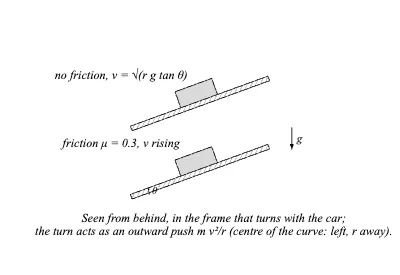
A car on a road banked at 20° round a 50 m curve, seen from behind in the frame turning with it. Without friction it holds at v = √(r g tan θ); with μ = 0.3 it holds up to v_max = √(r g (sin θ + μ cos θ)/(cos θ − μ sin θ)), then slides out.
Open this in the studioOpens as a new scene in Research mode, with its graphs and table. Free: open it, run it and change any value, no account needed. Graphs, tables, figure labels and every export are part of Pro.
What it shows
The formulas
- v_ideal = √(r g tan θ)
- v_max = √(r g (sin θ + μ cos θ) / (cos θ − μ sin θ))
- v_min = √(r g (sin θ − μ cos θ) / (cos θ + μ sin θ))
Where: r = 50 m the curve's radius, θ = 20° the bank angle, μ = 0.3 the friction coefficient, g = 9.81 m/s², v the car's speed. Shown from behind the car in the frame that turns with it, where the turn acts as an outward push m v²/r.