Over 60 classic problems are built in, in ten topics:
Motion and projectiles
Forces and friction
Energy, momentum and collisions
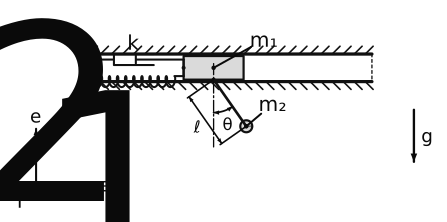
Oscillations
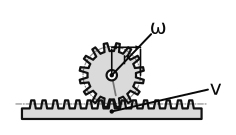
Circular motion and rotation
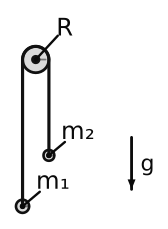
Pulleys, ropes and chains
Statics and structures
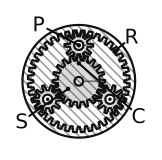
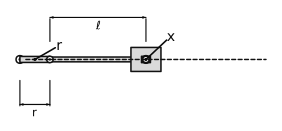
Machines and drives
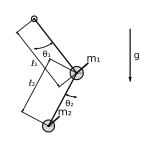
Complex mechanisms
Sandbox and play
Ordinate 2D Notes
Worked examples, checked against the hand calculation
Short papers that solve a classic problem by hand and compare it with the simulation. The figures and graphs are the studio's exports.
Ordinate 2D NotesStatics · No. 1
Member forces of a Warren truss by the method of joints
Solapsis · worked example
Abstract. A Warren truss carries a load at midspan. We find the support reactions and the force in every member from the equilibrium of the joints, and compare the fifteen forces of a simulation with the hand calculation.
1 Introduction
Truss members are slender bars joined by pins, so each carries only a force along its axis, in tension or compression. The method of joints finds these forces by treating each pin as a particle in equilibrium.
2 Theory
At every joint the forces on the pin sum to zero in both directions:
ΣFx = 0, ΣFy = 0.(1)
For a symmetric truss with a load mg at midspan, each support carries R = mg/2. An end diagonal that makes the angle θ with the horizontal then carries
F = mg2 sin θ (compression).(2)
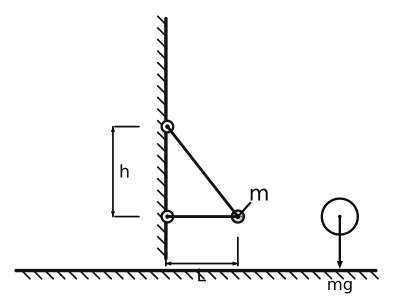
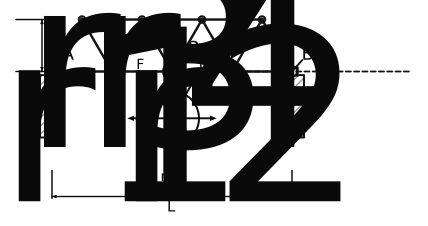
Figure 1. The truss, with the free-body diagram of the loaded joint P (rod forces Fr and the weight mg).
3 Results
The simulation reproduces the hand calculation for all fifteen members to within 0.002 N. Members at the ends are in compression and the bottom chord is in tension, as expected for a bridge.
References
Hibbeler, R. C. Engineering Mechanics: Statics. Pearson.
Beer, F. P., Johnston, E. R. Vector Mechanics for Engineers: Statics. McGraw-Hill.
Ordinate 2D NotesMechanisms · No. 2
The Peaucellier–Lipkin straight-line linkage
Solapsis · worked example
Abstract. A linkage of seven bars turns circular motion into exact straight-line motion. We show the inversion relation that makes it work and check the traced path in a simulation.
1 Introduction
For almost a hundred years, no one knew whether a linkage could draw an exact straight line. In 1864 Peaucellier found one, and Lipkin found it again in 1871. It needs no guide or slide, only pin joints.
2 Theory
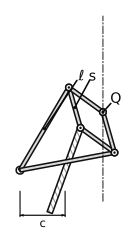
Two long links of length ℓ join the pole O to opposite corners of a rhombus of side s. The two other corners, P and Q, always lie on a line through O, and
OP · OQ = ℓ2 − s2.(1)
The point Q is the inverse of P in a circle about O. A circle through O inverts into a straight line, so if P is guided on such a circle by an extra link, Q moves on a line.
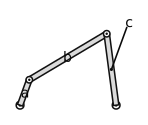
Figure 1. The linkage, exported from Ordinate 2D as SVG.
3 Results
The simulated point Q stays within 1 mm of a straight line over the whole stroke.
References
Kempe, A. B. How to Draw a Straight Line. Macmillan, 1877.
Norton, R. L. Design of Machinery. McGraw-Hill.
Ordinate 2D NotesVibrations · No. 3
Free decay of a damped spring–mass oscillator
Solapsis · worked example
Abstract. A mass on a spring with a viscous damper is released from rest. We give the three regimes of the response and the damped frequency, and compare them with a numerical solution.
1 Introduction
Damping decides whether a vibration rings, returns quickly or creeps back. The ratio of the actual damping to the critical value, ζ, describes all three cases with one number.
2 Theory
The equation of motion for the mass m, spring constant k and damping coefficient c is
mẍ + cẋ + kx = 0.(1)
With ω0 = √(k/m) and ζ = c/(2√(km)), the underdamped motion (ζ < 1) is
x(t) = Ae−ζω0t cos(ωdt + φ), ωd = ω0√(1 − ζ2).(2)
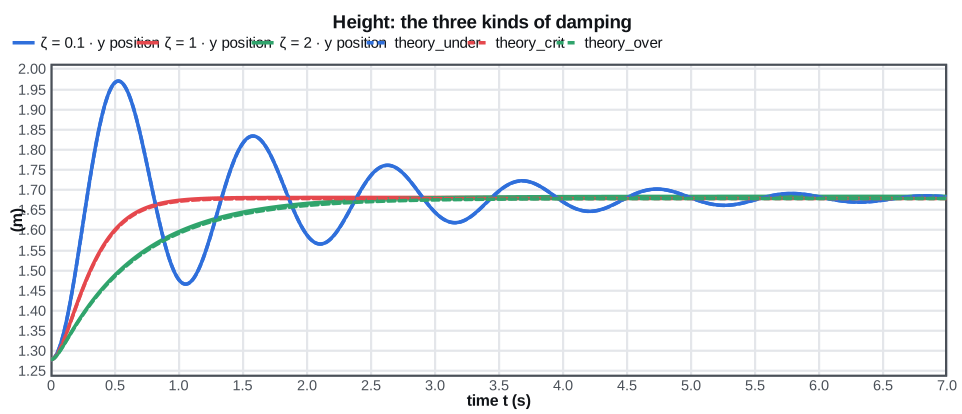
Figure 1. Three dampings, plotted by the studio with their theory curves.
3 Results
Three dampings were simulated: below, at and above ζ = 1. The numerical curves agree with the theory curves. At ζ = 1 the mass returns fastest without overshoot.
References
Thomson, W. T. Theory of Vibration with Applications. Prentice Hall.